
“Terror Online” International Contest seeks to combat censorship of artworks on social media
TEHRAN – In recent years, unusual trends have emerged across social media. One such example is the systematic removal of figures of the Axis of Resistance from various platforms. Masoud Shojai Tabatabai, the secretary of the first International Cartoon and Poster Contest “Terror Online,” made the remarks at a press conference for the event, held
TEHRAN – In recent years, unusual trends have emerged across social media. One such example is the systematic removal of figures of the Axis of Resistance from various platforms.
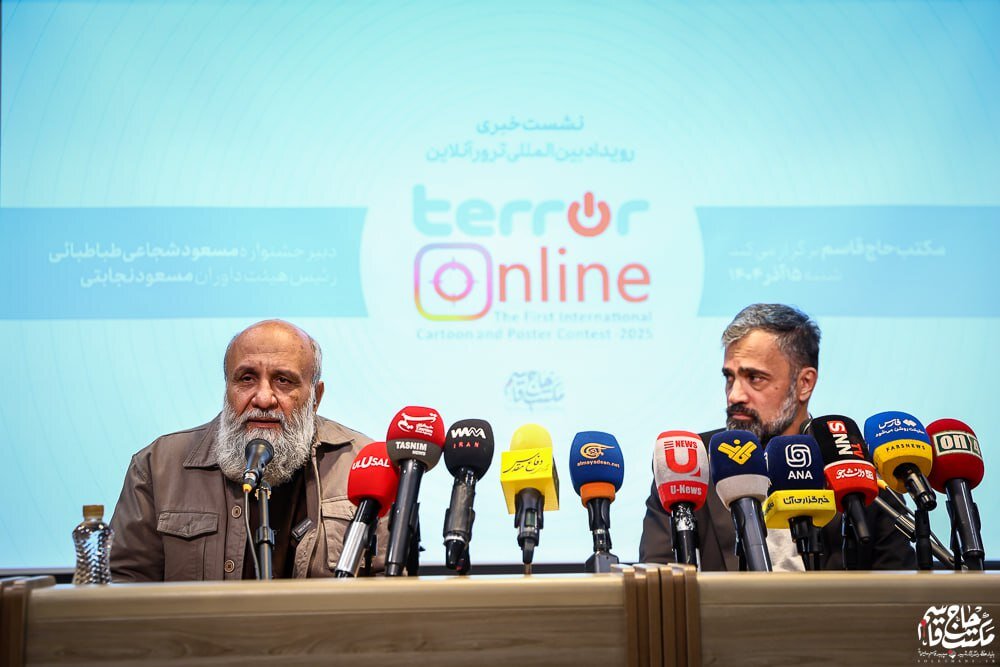
Masoud Shojai Tabatabai, the secretary of the first International Cartoon and Poster Contest “Terror Online,” made the remarks at a press conference for the event, held on Saturday in Tehran, ISNA reported.
The main goal of the event is to combat the censorship of artworks and present authentic visual narratives of the resistance culture by inviting both Iranian and international artists.
“We chose the subject ‘online assassination of Resistance heroes’ for the poster section, since, for various reasons, the ability to present images and narratives related to key figures of the Axis of Resistance has become increasingly restricted. We are dealing with a form of cyber terrorism that is expanding every day, with a significant portion of global violence now taking place not on the battlefield, but in the digital space,” Shojai Tabatabai noted.
“The deletion and blocking of pages and content related to Resistance leaders, such as the martyrs General Qassem Soleimani, Seyed Hassan Nasrallah, Ismail Haniyeh, and others, is an example of this trend. This is not merely a technical error but an attempt to erase narratives and censor the historical memory of nations,” he added.
“These circumstances led us to conclude that organizing such an event could provide an opportunity for domestic and international artists to present works related to cyber issues, digital censorship, and the truthful representation of the Axis of Resistance. In the cartoon section, considering the distinction between cartoon and caricature, we highlighted the critical and narrative aspects of this art form,” the secretary explained.
Shojai Tabtabai added that the content restrictions on three major platforms, Instagram, Twitter, and Facebook, which ostensibly defend freedom of expression, made holding such an event even more necessary.
He noted the broad participation of artists, stating, “more than 426 artists submitted 1,835 works from 61 countries, a figure that places this event among the most prestigious international competitions”.
“From Asia alone, 270 artists participated, along with 85 from Europe and a significant number from Latin America. Artists from Africa and North America also took part. Iran had the highest participation with 175 artists, followed by Indonesia and Turkey,” he underlined.
Regarding the selection of judges, he said: “Naturally, we invited judges from countries with higher levels of participation. For the cartoon and caricature section, experienced judges from Turkey, where participation was strong, were invited. Given the broad participation from Indonesia, one of that country’s leading figures in this field also joined the jury. Due to the meaningful participation of artists from Latin America, we also invited a renowned artist and graphic designer from the region to serve as a judge. The presence of judges from three continents added significant international credibility to the competition.”
For the domestic jury, the judging panel consisted of Masoud Nejabati (head of the jury), Abbas Naseri, and Mohammad Hossein Niroumand.
“The prizes were one of the strengths of the competition. In both the cartoon and poster sections, the first prize was €2,000, the second prize was €1,500, and five €500 awards were designated for each section. In total, €14,000 in cash prizes were awarded to the selected works. This level of valuation elevated the status of the festival among international events,” Shojai Tabatabai said.
He concluded by saying that the final ceremony of the event, attended by international judges and prominent global figures, is scheduled for January 5, 2026, at the Art Bureau in Tehran.
Also speaking at the event, Masoud Nejabati, head of the jury, said that the goal of the competition was to identify graphic designers aligned with the Resistance culture on an international scale, an area that, he noted, had long been neglected.
He emphasized that Shojaei Tabatabai had, for years, worked tirelessly in the field of cartoons and caricature, building a global network of artists, but that a similar network had not yet taken form in graphic design.
“As a result,” he said, “In certain critical moments when we want to organize a global event, we find ourselves with limited contacts, mostly among designers from neighboring countries who collaborate with the Axis of Resistance.”
“At first, the event was supposed to focus solely on cartoons, but at our request, the graphic design (poster) section was added so we could discover new designers along the way. Many of the designers who participated this year were new names to us, but these first steps are highly impactful,” Nejabati noted.
On the judging policy, he explained: “The number and quality of the submissions exceeded our expectations. However, we adopted a strict approach, and works produced using artificial intelligence were not allowed to enter the competition. Our aim was not to fill the exhibition with large numbers of works, but to select distinguished and impactful pieces. Out of 535 submissions, only 56 works passed the first stage. These works were evaluated once again, and ultimately a limited and standard number were chosen for exhibition and final judging.”
The head of the jury stated, “Several key criteria guided the selection process, including clarity of message, creativity, ideation, composition, and technique. What mattered to us was that viewers should receive the artwork’s message without ambiguity.”
Nejabati added that most reputable international festivals are held regularly, which encourages established designers and major brands to participate. “This is the first edition, and in my view, the results, especially given the level of international participation, are acceptable. If we can continue this event annually with either a fixed theme or coherent, well-defined themes, the number of participants and the quality of works will increase significantly.”
SS/