
Tehran cultural center to host reading performance of “A Marriage Proposal”
TEHRAN- On Tuesday, Arasbaran Cultural Center in Tehran will host a reading performance of Anton Chekhov’s comic play “A Marriage Proposal”. The performance will be directed by Alireza Nasehi with a cast composed of Amir Anvarian, Erfan Heidari, and Mahtab Ahmadi. “A Marriage Proposal” is a renowned one-act farce written between 1888 and 1889, premiering

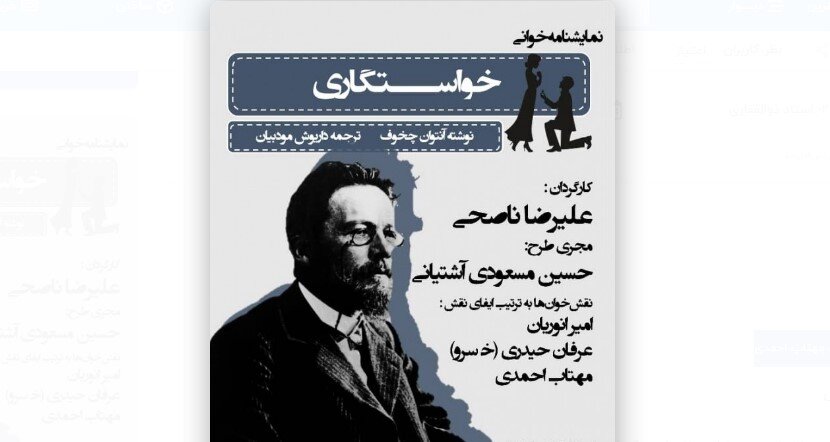
TEHRAN- On Tuesday, Arasbaran Cultural Center in Tehran will host a reading performance of Anton Chekhov’s comic play “A Marriage Proposal”.
The performance will be directed by Alireza Nasehi with a cast composed of Amir Anvarian, Erfan Heidari, and Mahtab Ahmadi.
“A Marriage Proposal” is a renowned one-act farce written between 1888 and 1889, premiering in 1890. Known for its rapid pace, witty dialogue, and situational humor, the play exemplifies Chekhov’s mastery of comedic timing and character dynamics. It revolves around a humorous and absurd clash of personalities, highlighting human pettiness and vanity through a lighthearted lens.
The story centers on Ivan Vassilevitch Lomov, a neighbor of Stepan Stepanovitch Chubukov. Lomov, a hypochondriac obsessed with his health, visits Chubukov’s house to propose marriage to the latter’s 25-year-old daughter, Natalya Stepanovna. After receiving Chubukov’s enthusiastic approval, Lomov prepares to make his proposal but is distracted when Natalya enters. In an awkward and comic sequence, Lomov attempts to express his intentions but ends up embroiled in a heated argument with Natalya over the disputed Oxen Meadows, a piece of land dividing their properties. Their dispute causes Lomov to suffer a sudden attack of palpitations and numbness in his leg.
As the argument intensifies, Chubukov joins in, furious that Lomov would dare propose marriage. He dismissively calls Lomov a “fool,” and, in a fit of rage, orders him out. However, Natalya, realizing Lomov’s intentions, becomes hysterical, begging her father to bring him back. Lomov reenters, and the two resume their quarrel—this time about which dog, Guess or Squeezer, is superior.
The argument exhausts Lomov, who collapses, prompting concern from his hosts. Miraculously, Lomov recovers, and Chubukov practically forces the young couple into accepting the marriage proposal. The play ends with another comedic argument—this time over their dogs—while Chubukov tries to restore calm and offers champagne.
“A Marriage Proposal” was an immediate success in its early performances in St. Petersburg and Moscow and quickly gained popularity in smaller Russian towns. Tsar Alexander III himself was reportedly fond of the play. Interestingly, Chekhov himself was dismissive of farces as serious literature.
Throughout the 20th century, the play was adapted and reinterpreted across different cultures and theatrical styles. In the 1920s, Vassar College staged it three times in a single evening, experimenting with realism, expressionism, and constructivism—each version highlighting different emotional and aesthetic dimensions. In one, actors wore masks, leaning towards tragedy, while another featured performers in work suits, tossing a ball in a playground setting.
In 1935, Soviet theater innovator Vsevolod Meyerhold fused “A Marriage Proposal” with Chekhov’s other short plays, “The Bear” and “The Anniversary”, into a three-act piece titled “33 Swoons”, a satirical critique of the pre-revolutionary intelligentsia’s pretensions. The play’s influence extended globally, with adaptations such as the Australian TV version in 1957 and a parody in the 1972 Soviet slapstick film “My God, Ilya!”.
More recently, in 2016, the play was staged three times at St. Werburgh’s Church Parish Hall in Manchester, England, demonstrating its enduring appeal. Additionally, Indonesian filmmaker Benyamin Sueb adapted “A Marriage Proposal” into a film called “Pinangan” in 1976.
SAB/